

The Hidden Dangers of Letting Foot Pain and Knee Pain Linger
Sunday, 01 March 2026

Foot pain and knee pain are often brushed off as “just overuse,” “age catching up,” or something that will settle with rest. Most people ignore foot pain and knee pain at the beginning.
But when pain persists, even mildly, it is often a sign that something deeper is wrong with your foot mechanics, joint alignment, or tissue health.
In clinical reality, persistent foot problems and knee problems rarely stay isolated. When left untreated, they frequently worsen, spread, and become significantly harder and more expensive to manage.
As podiatrists, we regularly see patients who waited months before seeking help and wished they had sought help earlier. This article explains why lingering foot pain and knee pain should never be ignored, and what early intervention can prevent.
Identifying The Types Of Pain & Conditions
Pain is a symptom. It tells you something is mechanically or structurally wrong.
Common complaints include:
- Heel pain when taking first steps in the morning
- Arch pain after long hours of standing
- Pain at the ball of the foot
- Ankle pain or instability
- Knee pain when climbing stairs
- Knee pain after running or exercise
- Swollen knee after activity
These symptoms are often linked to underlying conditions such as:
- Plantar fasciitis
- Flat feet (collapsed arches)
- High arches
- Bunions
- Tendon inflammation
- Knee cap tracking problems
- Early cartilage wear
By the time pain becomes noticeable, the underlying mechanical stress has often been present for weeks or months.
Without podiatric assessment, patients treat the symptom (painkillers, massage, rest) but the mechanical issue remains.
Over time, this creates a cascade effect.
Common Warning Signs You Should Not Ignore
You should not ignore:
- Heel pain lasting more than 1–2 weeks
- Arch pain after short periods of standing
- Knee pain when climbing stairs
- Knee pain after running
- Swelling around the knee joint
- Stiffness in the morning
- Frequent ankle sprains
- Increasing bunion deformity
- Uneven shoe wear patterns
Persistent symptoms indicate the body is not adapting well to load.
Compensation: How Foot Pain Leads to Knee Problems
Your feet are the foundation of your body. Every step you take transmits force from the ground upward. If your foot mechanics are abnormal, your knee absorbs the consequences.
Example: Flat Feet and Knee Pain
Flat feet (collapsed arches) often cause excessive inward rolling of the ankle. This changes the alignment of the lower limb and increases stress on the inner knee.
Over time, this may lead to:
- Anterior knee pain
- Medial knee pain
- Cartilage wear
- Early knee arthritis
Example: Heel Pain and Compensation
If you have chronic heel pain, you may unconsciously shift your weight to the outer foot or shorten your stride. This alters how force travels through your knee and hip.
Compensation patterns are one of the most common reasons knee pain develops after foot pain.
Ignoring early foot pain can therefore lead to:
- Patellofemoral pain (pain in front of knee)
- IT band pain
- Medial knee pain
- Early knee arthritis
When Chronic Inflammation Becomes Structural Damage
In the early stage, many foot and knee conditions are inflammatory.
Examples include:
- Plantar fascia inflammation
- Achilles tendon irritation
- Knee tendon inflammation
- Mild ligament strain
At this stage, conservative treatment is highly effective.
However, when pain lingers for months:
- Tissue thickening occurs
- Micro-tears accumulate
- Joint cartilage starts wearing down
- Tendons degenerate
At this stage, the condition is no longer purely inflammatory, it becomes degenerative. Degenerative conditions require longer rehabilitation and are more prone to recurrence.
This is why early diagnosis matters.
Reduced Activity → Weight Gain → Worse Joint Stress
When experiencing foot pain or knee pain, most people instinctively reduce activity.
They may reduce or stop:
- Running
- Gym workouts
- Long walks
- Sports
- Hiking or travel
- Shopping
While short-term rest is appropriate, prolonged inactivity leads to:
- Muscle weakness
- Reduced joint stability
- Weight gain
- Increased load on already stressed joints
Even a small increase in body weight significantly increases force through the knee with every step.
The longer pain lingers, the harder it becomes to regain strength and normal function.
Early Knee Joint Stress Can Lead to Premature Wear
The knee joint is designed to handle load but only when alignment is optimal.
When foot structure alters alignment, the knee experiences uneven pressure distribution.
Over time, this may contribute to:
- Cartilage thinning
- Meniscus strain
- Joint stiffness
- Early degenerative changes
Patients are often surprised to learn that mild recurring knee pain in their 30s or 40s can be an early warning sign of progressive joint stress.
Addressing biomechanics early can reduce long-term joint deterioration.
The Cost of Delaying Assessment
When patients delay seeking care, treatment often becomes more complex.
Early-stage management may involve:
- Detailed biomechanical assessment
- Gait analysis
- Foot posture evaluation
- Footwear modification
- Strength and stability exercises
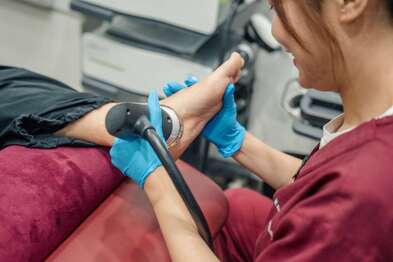
- Targeted shockwave therapy
When conditions become chronic, management may require:
- Longer rehabilitation
- More intensive therapy
- Extended activity modification
- Higher risk of recurrence
Early intervention is typically simpler, faster, and more cost-effective.
When Should You Seek Help?
Consider seeing a podiatrist if:
- Pain persists beyond two weeks
- Pain keeps returning
- You have flat feet with knee discomfort
- Exercise consistently triggers symptoms
- You notice structural changes in your feet
- Daily activities are becoming uncomfortable
The earlier the evaluation, the easier the correction.
Book an Appointment
Opening Hours
With five conveniently located clinics in Bukit Timah, Kembangan, Novena, and Orchard & Marine Parade, we provide thorough reviews and personalised care methods to address a wide range of lower limb issues that you or your family members might face. From initial assessment to tailored care plans, we ensure that every step of your journey is handled with expertise and attention to detail.
Mon to Sat - 9am to 6pm, Sun & Public Holidays - Closed
We recommend that you schedule an appointment prior to visiting our clinics.
Orchard
302 Orchard Road
Tong Building #09-02 (Rolex Centre)
Singapore 238862
Tel: +(65) 6884 4123
Kembangan
18 Jalan Masjid
Kembangan Plaza #B1-02
Singapore 418944
Tel: +(65) 6848 5156
Novena
10 Sinaran Drive
Novena Medical Centre #08-13
Singapore 307506
Tel: +(65) 6235 2132
Bukit Timah
1 Fifth Avenue
Guthrie House #02-04
Singapore 268802
Tel: +(65) 6235 9080
Marine Parade
80 Marine Parade Rd
Parkway Parade #08-04
Singapore 449269
Tel: +(65) 6592 8082